Showing posts with label Prepping. Show all posts

Sunday, February 12, 2012

Nine Great Emergency Light Sources Other Than Flashlights

This is a post that I ran across on Daily Survival.  This can be used in case of thunderstorms, tornadoes, hurricanes, earthquakes or any other natural disaster.

Nine Great Emergency Light Sources Other Than Flashlights

Original Article
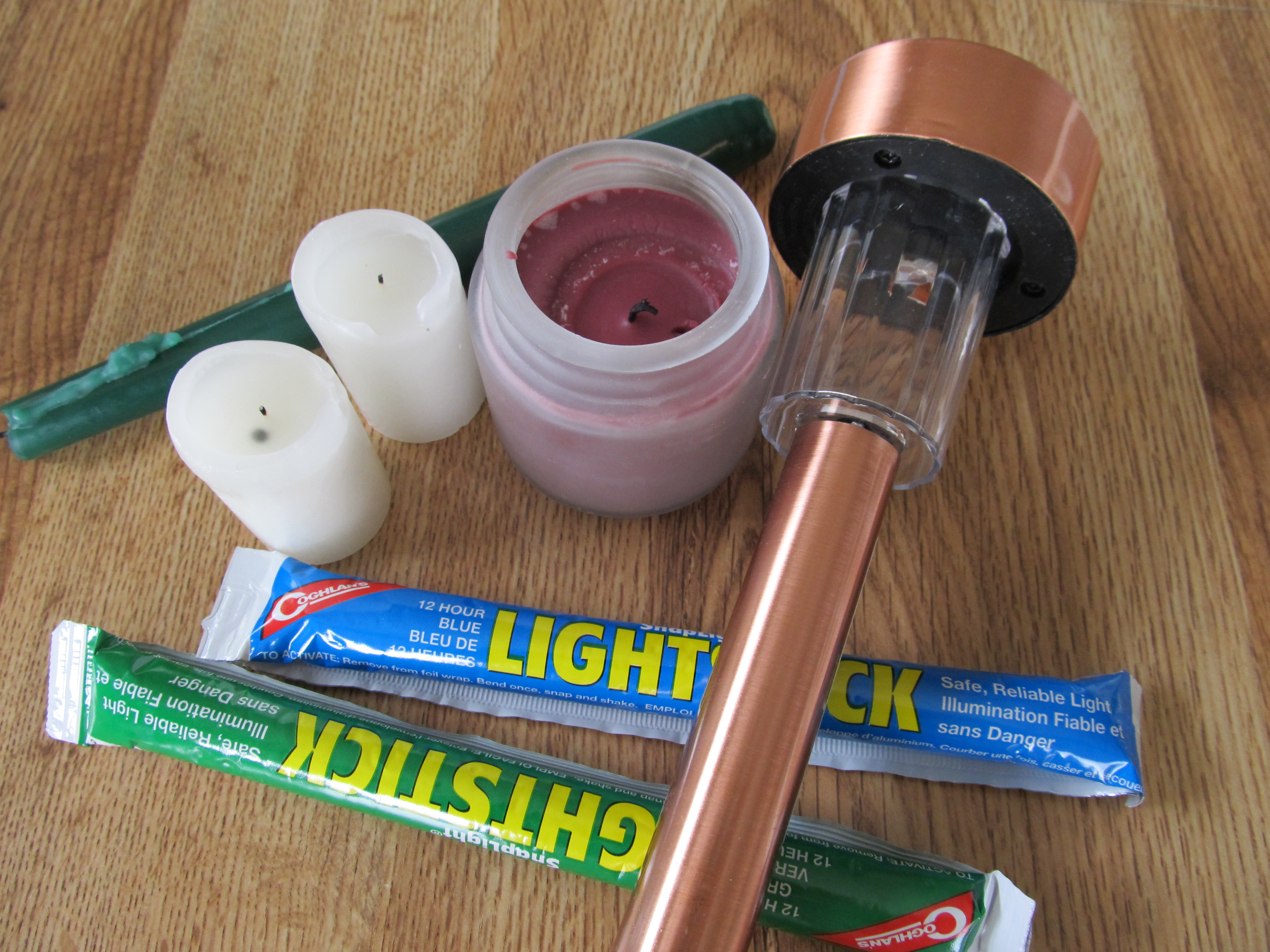


So the lights go out and you feel around to get the flashlight that you had stashed in its secure location on top of the refrigerator (stepping on somebody’s blocks and toy soldiers in the dark on the way) and to your horror you find that your handy flashlight isn’t there! Someone used it and didn’t put it back.  So you stumble through your house to your bathroom and find the flashlight you keep there with dead batteries.  Yep, this actually happened at my house once.

Fortunately, I believe in having a backup plan, and usually a backup to that backup plan, so what else can you use to get some light in your house while the power is out?  Here are 9 great emergency light sources when you’re not using your trusty flashlight.  And for the purpose of this post, I’m excluding everything that works like a flashlight (headlamp, keychain lights, crank/shake powered flashlights, etc.).

1. Any backlit electronic device you have handy. Your cell phone, laptop, tablet computer, mp3 player, even an indiglo wristwatch will give off enough light to get you to another light source. There are cell phones equipped with a flashlight, but just the glowing face gets you a good amount of light to go by.

2.  Lighter.  Your lighter isn’t going to put out enough light to eat dinner by, but it can get you enough light to find another source of light.  This is the first of a few of our light sources that are an open flame.  Of course use caution and don’t use the open flame lights if there’s a possibility your gas line is leaking, if you’re going to fall asleep, or around other flammable objects.  You all know that, right?  Okay, on with the list.

3.  Candles. Keep a few somewhere you’ll be able to get to them fairly easily. Don’t bury your box of candles out in the shed under a bunch of other boxes. Keep some in the house ready to be lit for emergency light.

4.  Fire.  This works outside of course, but if you have a fireplace or wood/coal stove in your house, you can use it to get some light going.  And a good fire will also give you heat which you may be needing with no power.

5. Light sticks. These are great for the kids for a morale boost. They put out a fair amount of light, but are a one time use product, so you’ll want a handful of them on hand if you’re planning on using them frequently or for much light.
6.  Gas stove.  The flame from a gas stove isn’t very “bright”–it burns mostly blue flame, and it’s not at all portable, but it is a source of light.
7.  Oil lamps.  You can use these with lamp oil, cooking oil, or kerosene.  Oil lamps can be purchased at camping type stores or online, or if you’re crafty you can make your own.

8. Solar outdoor path lights.. The kind on a stick that light up your walk at night. These are awesome. They come in varying strengths, and they don’t require any fuel or batteries–just put them outside during the day and bring them in at night for some easy lighting. You probably already own some.

9. Camping lantern. These are the lanterns that use Coleman type fuel either in a pressurized tank or in the screw on bottles. They put out a lot of light. Make sure you have fuel and extra mantles if your lamp requires them. There are camping lanterns that are battery powered as well. These lanterns are great for lighting entire rooms.

There you go.  No reason to go about living in the dark even if all your flashlight batteries are dead.  Enjoy some light with one of these alternate emergency lighting sources.

Thursday, December 22, 2011

Conserve

One of the best ways to save money is to conserve - Here are some ways how:

  • Turn off the lights when you are not in the room - remind your family to also!
  • Turn off and unplug appliances when not in use!
  • Have your cooling and/or heating system tuned up once a year!
  • Plan your errands ahead of leaving the house so you save on gas!
  • Hold clothing swaps!
  • If needed, insulate with blankets by hanging over the windows to protect against the cold.  A wool blanket or sleeping bag will work wonders for keeping the cold out of the room.

Tuesday, November 8, 2011

Do Your Kids Know Their Basics?

It always amazes me how some 12-14 year olds would not be able to get home if they needed to.  My youngest son is 12 and in some ways is eons beyond his peers.  Here are some simple things every child should know:

Name and how to spell it

Your Name and how to spell it

Address

10 digit phone number

How to read road signs

How and Where to look for place markers

This may sound silly to some, but it's surprising the lack of common sense things kids know today.

It's amazing that some cannot even state that the Sun rises in the East and sets in the West.  Every child should know how to read a map and a compass.  Not the electronic versions either!

Wednesday, October 26, 2011

Goals: Setting and Maintaining

It's amazing how many people say they want to do something and never really formulate a plan on how to do it.  Setting and maintaining goals is the one way to reach that milestone.

My favorite:  "I wanna lose weight."

"Ok.  So how are you going to do it?"

"Oh, I guess I'll go join a gym or something"

No real plan.

First, in the example above - how much weight do you want or need to lose?  Set a plan into motion on losing weight - walking, running, hiking, swimming, or put on your appointment book exactly how often or when you will be going to the gym.  GET UP OFF THE COUCH!

Of course goals are much more than the example given.  Look at the big picture and set lifetime goals.  Goals can relate to:
  • Career
  • Financial
  • Education
  • Family
  • Artistic
  • Attitude
  • Physical
  • Pleasure
  • Public Service
Within your catagories, set short term goals or in other words "make a 5 year plan".
Consider your 5 year plan a "to-do" list.

Another example:  I grew up in poverty.  I was a child of the welfare system and lived in subsidized housing.  I always wanted to go to college, but after living with different relatives and switching high school six times, it was not an option when I graduated high school.  So at 27, I started college.  It took me 9 years, but I graduated in 1999 at the age of 35 with B.A. from Our Lady of the Lake University in San Antonio.  It can be done.  It just takes a plan.

Monday, October 24, 2011

Buying and Storing Non-Perishable Foods

Buying non-perishable foods on sale is a great way to stock up.  There are several options:

Cans - Usually good for 2 years.  Will have an expiration date printed on them.  I usually take a black permanent market and write month/year on front.

Bags - For flour, brown and powdered sugars and baking goods, I usually store in the freezer for at least a week.  Then seal in a ziploc gallon size bag to make sure there are no uninvited guest.  The same with Pasta.

Jars - Are like cans.  You will have a printed expiration date.  Mark it on the front in permanent marker.  Also, make sure the jars are in a secure location so they will not fall.   Second thing to look for is a reusable jar.  When I buy Spaghetti Sauce, I only buy the sauces that come in the canning jars.  They can be re-used, traded, or sold.

Boxes - Boxes can be treated differently depending on what and how it is packaged.  For instance - Hamburger Helper is in sealed envelopes within the box.  So it can be easily stored on the shelf.  Pasta, however is usually loose inside the box.  If you plan on keeping it for any period of time, it is best to take it out of the box and put it into either a plastic container or a sealed bag.

Just a note - the expiration dates on foods are not really expiration dates.  Some links with more information are here, here, here, and here.

Another option, if you are looking at storing food is the freeze dried and dehydrated food.

While there are many sources for this, two of the best I have found is:

Honeyville Farms

Emergency Essentials


Remember, shop well, shop smart!

Be Sure and Vote!

I'm not going to tell you how to vote - but this is the advice that I give most people that I meet.

Make a list of items that are important to you.  It may include (but not limited to):
  • Jobs
  • Education
  • Environment
  • Economy
  • Military
  • Regulations
  • Housing
  • Deficit Spending
  • Lower Taxes
  • Smaller Government
Look at each party's platform:
Research your candidates.  Do not just blindly go with a party.

Register!

VOTE!!!

Sunday, October 23, 2011

Preparing for Public Rioting and Looting

These occupy people and their promise of violence have got me to thinking.  Last week, they marched on Bank of America, 1 block away from where I work.

What happens when a riot or looting occur in an area where you live or work?  There are options.

Avoid the area if you are not in the area - do not go in!

Leave the area - This may not be as simple as it sounds.

Starting now keep your eyes open:
  • Look for tunnels to escape through.  I found a way out of my building by accident.
  • Look for culverts and/or ditches that can keep you out of the main area where the rioting and/or looting is taking place.
  • Look for sky bridges between buildings that you can use to avoid the ground where the rioters and/or looters are.
  • Find alternate routes from and to work/home.
Staying put:
  •  Do you have food and water in your vehicle?
  • Do you have protections in your vehicle?  Guns and/or pepper spray?  Do you have the correct permits to carry a gun?
  • Do you park close to your building?  Can you make it to your car safely?
 All things to think about.  Especially this coming year.

Sunday, August 14, 2011

Hurricane Season: Transportation

The question is - If you decide to evacuate, how do you get out of town?

If you do not have a car, start looking into what programs your city or town will offer for evacuation, this way you know where to go.

Also, start looking local bus routes, ticket rates, and schedules.  Be sure you know where the bus station is.  This way you will know when and where you have to be.

For you car, you will want to make sure you car is in good running order.

First, when you find out the hurricane is headed your way, fill up your car.  Even if the hurricane does not strike where you are, you can use this gas in the future.

Next, make sure that your car is in good working order. 
Has the oil been changed recently?  If not, you may want to go ahead and do that now.  The average is 3,000 miles, maximum is 5,000 miles for most cars.  If you are evacuating - make sure you have 2 extra quarts of oil. 

Does your car have adequate coolant?  It is best to have at least 1 extra gallon.

When is the last time your headlights or bulbs were changed?  It is best to have at least one extra headlight bulb and extra turning light bulbs.

Wiper blades and window washer are important.  If you are caught in the rain while evacuating, you will want to make sure you are able to see while driving.

Fuses, jumper cables, fix-it sealer, clear plastic and duct tape(in case a window becomes broken) are also things to consider.  Make sure you have a good jack and tire wrench.

Just remember, in evacuation there will be a lot of people on the roads, be courteous and be careful!

Friday, August 12, 2011

Hurricane Season: Disaster Kit

So what exactly goes into a disaster kit?  Planning for more than just a hurricane.  I've copied some tips from the Ready South Texas website:

Food and Water:

Water
bullet
One gallon of water per person per day, for drinking and sanitation.
bullet
Children, nursing mothers, and sick people may need more water.
bullet
If you live in a warm weather climate more water may be necessary.
bullet
Store water tightly in clean plastic containers such as soft drink bottles.
bullet
Keep at least a three-day supply of water per person.
Food
bullet
Store at least a three-day supply of non-perishable food.
bullet
Select foods that require no refrigeration, preparation or cooking and little or no water.
bullet
Pack a manual can opener and eating utensils.
bullet
Choose foods your family will eat:
bullet
Ready-to-eat canned meats, fruits and vegetables
bullet
Protein or fruit bars
bullet
Dry cereal or granola
bullet
Peanut butter
bullet
Dried fruit
bullet
Nuts
bullet
Crackers
bullet
Canned juices
bullet
Non-perishable pasteurized milk
bullet
High energy foods
bullet
Vitamins
bullet
Food for infants
bullet
Comfort/stress foo


Medical Supplies:
Things you should have:
bullet
Two pairs of Latex, or other sterile gloves (if you are allergic to Latex).
bullet
Sterile dressings to stop bleeding.
bullet
Cleansing agent/soap and antibiotic towelettes to disinfect.
bullet
Antibiotic ointment to prevent infection.
bullet
Burn ointment to prevent infection.
bullet
Adhesive bandages in a variety of sizes.
bullet
Eye wash solution to flush the eyes or as general decontaminant.
bullet
Thermometer (Read more: Biological Threat)
bullet
Prescription medications you take every day such as insulin, heart medicine and asthma inhalers. You should periodically rotate medicines to account for expiration dates.
bullet
Prescribed medical supplies such as glucose and blood pressure monitoring equipment and supplies.
Things it may be good to have:
bullet
Cell Phone
bullet
Scissors
bullet
Tweezers
bullet
Tube of petroleum jelly or other lubricant

Non-prescription drugs:
bullet
Aspirin or nonaspirin pain reliever
bullet
Anti-diarrhea medication
bullet
Antacid (for upset stomach)
bullet
Laxative


Special Needs:
For baby:
bullet
Formula
bullet
Diapers
bullet
Bottles
bullet
Powdered milk
bullet
Medications
bullet
Moist towelettes
bullet
Diaper rash ointment
For adults:
bullet
Ask your doctor about storing prescription medications such as heart and high blood pressure medication, insulin and other prescription drugs.
bullet
Denture needs
bullet
Contact lenses and supplies
bullet
Extra eye glasses

For seniors:
bullet
Plan how you will evacuate or signal for help.
bullet
Plan emergency procedures with home health care agencies or workers.
bullet
Tell others where you keep your emergency supplies.
bullet
Teach others how to operate necessary equipment.
bullet
Label equipment like wheelchairs, canes or walkers.

Additional supplies for seniors:
bullet
List of prescription medications including dosage in your supply kits. Include any allergies.
bullet
Extra eyeglasses and hearing-aid batteries.
bullet
Extra wheelchair batteries or other special equipment in your supply kit.
bullet
A list of the style and serial numbers of medical devices such as pacemakers in your emergency supply kits.
bullet
Copies of medical insurance and Medicare cards.
bullet
List of doctors and emergency contacts.
For People with Disabilities:
bullet
Create a support network to help in an emergency.
bullet
Tell these people where you keep your emergency supplies.
bullet
Give one member of your support network a key to your house or apartment.
bullet
Contact your city or county government's emergency information management office. Many local offices keep lists of people with disabilities so they can be located quickly in a sudden emergency.
bullet
Wear medical alert tags or bracelets to help identify your disability.
bullet
If you are dependent on dialysis or other life sustaining treatment, know the location and availability of more than one facility.
bullet
Show others how to operate your wheelchair.
bullet
Know the size and weight of your wheelchair, in addition to whether or not it is collapsible, in case it has to be transported.

Additional Supplies for People with Disabilities:
bullet
Prescription medicines, list of medications including dosage, list of any allergies.
bullet
Extra eyeglasses, hearing aid batteries and cane.
bullet
Extra wheelchair batteries, oxygen.
bullet
Scooter or wheelchair patch kit, extra inner tubes and other repair supplies. Also include heavy gloves for wheeling over glass and debris.
bullet
Keep a list of the style and serial number of medical devices.
bullet
Medical insurance and Medicare cards.
bullet
List of doctors, relatives or friends who should be notified if you are hurt.
Other items to consider:
bullet
Pads and pencils for communication and/or to keep track of instructions you may receive
bullet
Power converter for communicating with a lap top computer
bullet
Animal supplies


A Portable Kit:
Emergency supplies
Water, food, and clean air are the essential items for survival. Each family or individual's kit should be customized to meet specific needs, such as medications and infant formula. It should also be customized to include important family documents.

Recommended supplies to include in a portable kit:
bullet
Water, amounts for portable kits will vary. Individuals should determine what amount they are able to both store comfortably outside the home and be able to transport to other locations
bullet
Food, at least a three-day supply of non-perishable food
bullet
Battery-powered radio and extra batteries
bullet
Flashlight and extra batteries
bullet
First Aid kit
bullet
Whistle to signal for help
bullet
Dust mask or cotton t-shirt, to help filter the air
bullet
Moist towelettes for sanitation
bullet
Wrench or pliers to turn off utilities
bullet
Can opener for food (if kit contains canned food) 

 
bullet
Plastic sheeting and duct tape to shelter-in-place
bullet
Infant formula and diapers, if you have an infant
bullet
Garbage bags and plastic ties for personal sanitation 


So after all this- what was the one thing not on the list?? 

TOILET PAPER!


I would buy at least a 4 pack if I were evacuating.  Think about this, if you are leaving an area along with a few hundred thousand other people, and have to stop at rest stops, what is the first thing that's going to be gone?

These kits are good for preparation for other disasters too.  Not only hurricanes, but also earthquakes, blizzards (although you may want to add a heavy coat or sleeping bag), fires, or flooding.